AEO Guide: How to Appear in ChatGPT & Monitor Your Brand’s Performance

ChatGPT had 900 million weekly users in February 2026. 77% of Americans now use it as a search engine. And if someone asks “What’s the best [your product category]?” and your brand doesn’t show up, you don’t exist in that conversation.
No second page. No “scroll down to see more results.” You’re either in the answer or you’re invisible.
This isn’t traditional SEO. ChatGPT gives one synthesized answer, and if you’re not in it, you just lost a potential customer.
This shift has created a new discipline: AEO (Answer Engine Optimization) — optimizing your brand to appear inside AI-generated answers, not just search rankings.
Here’s what actually works today, and how to measure whether your efforts are paying off.
What AEO Means (And Why Traditional SEO Isn’t Enough)
Traditional SEO optimizes pages for rankings. AEO optimizes entities, credibility signals, and citations so AI systems consider your brand trustworthy enough to recommend.
ChatGPT doesn’t simply rank websites. It:
- Synthesizes information from multiple sources
- Cross-verifies claims across platforms
- Prioritizes consensus and authority
- Selects brands it can confidently recommend
If your brand isn’t part of that information ecosystem, you effectively don’t exist in AI conversations.
What ChatGPT Actually Cites
Forget what you thought you knew about ChatGPT and Bing. New data from February 2026 shows ChatGPT pulls from completely different sources than traditional search engines.
Where ChatGPT actually gets its answers:
1. YouTube (16% of all citations)
YouTube overtook Reddit in late 2025 and now appears in 16% of LLM answers. ChatGPT cites specific videos 85% of the time—not channels. Video optimization matters more than subscriber count.
2. Reddit (10% of citations, but growing fast)
Reddit’s citation share grew 73% between October 2025 and January 2026. For Perplexity, 24% of all citations come from Reddit. But here’s the catch: 99% of Reddit citations point to individual discussion threads, not profiles or subreddit pages.
3. Wikipedia (47.9% of ChatGPT’s top 10 sources)
Wikipedia still dominates ChatGPT citations. If your category has a Wikipedia page and you’re mentioned, you’re golden. If not, you need other signals.
4. LinkedIn (second-highest social platform)
47% of LinkedIn citations come from personal profiles, 21% from company pages. Personal thought leadership beats corporate content.
5. Review sites (3x citation boost)
Domains with profiles on G2, Capterra, Trustpilot, Yelp, or Sitejabber are 3x more likely to be cited by ChatGPT.
What doesn’t matter as much:
- Bing rankings (the old advice is outdated)
- Your website alone (unless it has massive authority)
- Instagram, Facebook, X/Twitter (low citation rates)
How to Appear in ChatGPT: 6 AEO Best Practices
1. Create YouTube Videos (Not Just Written Content)
YouTube now appears in 16% of AI-generated answers—more than any other platform. But ChatGPT cites specific videos, not channels.
What works:
- Long-form explainer videos (10-30 minutes)
- Tutorial and how-to content
- Detailed product comparisons or reviews
- Include transcripts (YouTube auto-generates them, but edit for accuracy)
- Use clear, descriptive titles: “How to Choose Project Management Software for Remote Teams” beats “Our Product Demo”
Why it matters: LLMs parse video transcripts. A 15-minute video with a transcript is more citable than a 500-word blog post.
Quick win: Repurpose your best blog posts into YouTube videos. Add a transcript. Optimize the title for conversational queries.
2. Participate in Reddit Discussions (Authentically)
Reddit citations grew 73% in the past 4 months. But here’s the critical part: 99% of Reddit citations point to individual threads, not brand profiles.
What works:
- Answer real questions in relevant subreddits (r/SaaS, r/startups, r/marketing, r/entrepreneur)
- Write complete, detailed answers (not one-liners)
- Include your expertise, not just a link to your site
- Target discussions with multiple perspectives (ChatGPT favors threads with debate)
What doesn’t work:
- Posting on your company subreddit (won’t get cited)
- Generic “check out our product” comments
- Only linking without context
Example: Instead of “We solve this problem,” write: “I’ve worked with 15 SaaS companies on this exact issue. Here’s what I’ve seen work: [detailed answer]. Full disclosure, I run a consultancy in this space, but these strategies apply regardless of who you hire.”
Reddit CEO Steve Huffman: “Reddit performs best on questions that have multiple perspectives. It’s not about the one answer, it’s about the discussion.”
3. Optimize Your LinkedIn Presence (Personal > Corporate)
LinkedIn is the second-highest cited social platform. But personal profiles get 47% of citations vs 21% for company pages.
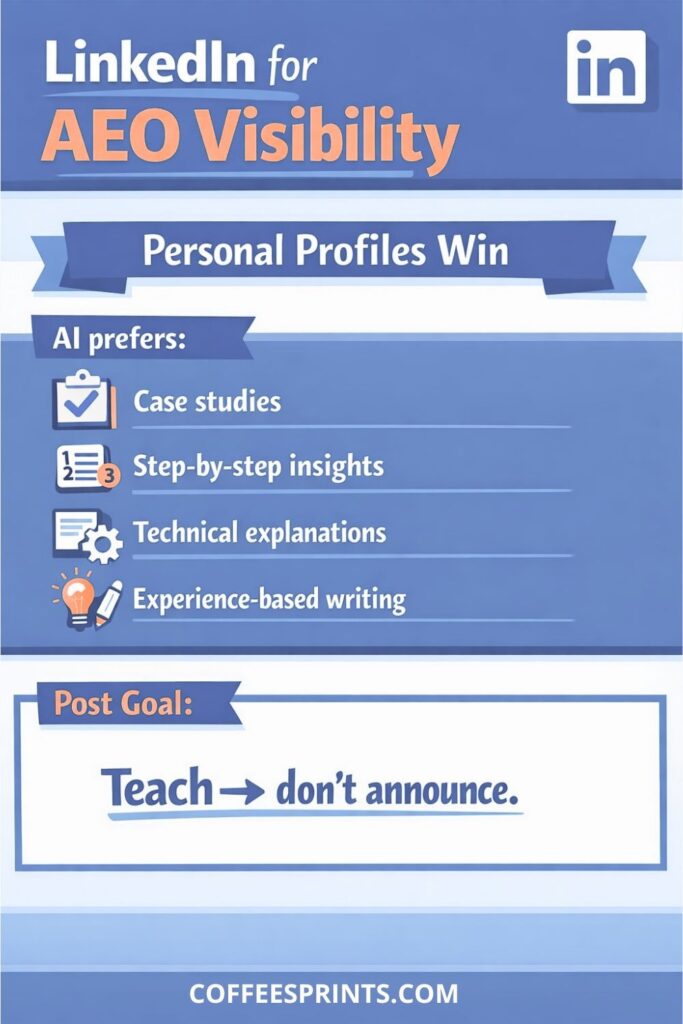
What works:
- Publish LinkedIn articles (not just posts) with clear, step-by-step insights
- Write from personal experience: “In my 10 years doing [X], here’s what I’ve learned…”
- Use detailed, technical explanations (ChatGPT favors professional how-to content)
- Post consistently (6-12 detailed posts/month)
What doesn’t work:
- Corporate press releases
- Generic “we’re hiring” posts
- Vague thought leadership without actionable details
Quick win: Turn your best case study into a LinkedIn article. Include specific metrics, what you did, and why it worked.
4. Get Listed on Review Sites (3x Citation Boost)
Domains with profiles on G2, Capterra, Trustpilot, Sitejabber, or Yelp are 3x more likely to be cited by ChatGPT.
Priority list:
- B2B SaaS: G2, Capterra, GetApp
- Local business: Yelp, Google Business Profile
- Ecommerce: Trustpilot, Sitejabber
- Services: Clutch (for agencies/consultancies)
Why it matters: ChatGPT cross-references sources. If you’re on multiple review sites with consistent info, you look credible.
Quick win: Claim your G2 profile this week. Add your description, pricing, and 3-5 customer reviews.
5. Get Millions of Brand Mentions on Quora & Reddit
Domains with millions of brand mentions on Quora and Reddit have 4x higher chances of being cited.
What this means: You need to be mentioned by other people, not just by yourself.
How to get mentioned:
- Answer Quora questions in your category (include your brand when relevant)
- Encourage customers to mention you in Reddit discussions
- Get featured in “What’s the best [X]?” threads
- Build a community that talks about you organically
6. Build Domain Authority (Still Matters)
Sites with 32,000+ referring domains are 3.5x more likely to be cited than sites with under 200.
What works:
- Guest posts on industry blogs
- PR coverage in news outlets
- Podcast appearances (show notes include your site link)
- Partnerships with established brands
Quick win: Pitch 3 industry blogs for guest posts this month. Target sites with 10k+ DR in Ahrefs.
Content Structure That Gets Cited
44.2% of all citations come from the first 30% of your content (the intro).
What it means for you: Answer the question immediately. Don’t bury the answer 800 words deep.
What ChatGPT favors:
- Answer-first structure (put the answer in paragraph 1)
- Bullet points and numbered lists
- Clear H2/H3 subheadings
- FAQ sections
- Tables and comparison charts
- Short paragraphs (2-3 sentences)
What ChatGPT ignores:
- Long intro paragraphs
- Fluffy copywriting (“innovative solutions,” “industry-leading”)
- Content that takes 5 paragraphs to get to the point
Example:
❌ Bad: “In today’s rapidly evolving digital landscape, businesses are increasingly seeking innovative solutions to streamline their operations. Over the past decade, we’ve seen a transformation in how companies approach…”
✅ Good: “The best project management tool for remote teams is Asana. Here’s why: real-time collaboration, integrations with Slack and Google Drive, and Gantt chart timelines. Here’s how to choose…”
Recommended Read:
How to Monitor Your Brand Citations in ChatGPT
Here’s the problem: ChatGPT gives you zero analytics. No impressions data. No Search Console. Nothing.
You have to monitor it yourself.
Manual Method (Free)
Step 1: Ask ChatGPT questions your customers would ask.
Examples:
- “What’s the best [your product category]?”
- “What’s a good [your service] for [your ICP]?”
- “Who are the top [your niche] consultants?”
Step 2: Enable web search (click the globe icon) and see if you appear.
Step 3: Track it in a spreadsheet: Prompt | Date | Mentioned? | Position | Competitors Mentioned
Do this once a week for 10-15 relevant prompts.
Automated Method (Paid Tools)
If you’re serious about tracking, use a dedicated AI visibility tool:
OtterlyAI ($29/month)
- Tracks brand mentions across ChatGPT, Perplexity, Google AI Overviews
- Shows “Share of AI Voice” (% of citations you own vs competitors)
- Daily updates with historical data
SE Ranking ChatGPT Tracker ($71/month add-on)
- Prompt-level tracking (specific questions, not just keywords)
- Shows exact context where your brand appears
- Daily updates + historical trends
Ahrefs Brand Radar (Part of Ahrefs subscription)
- Tracks ChatGPT mentions alongside traditional SEO
- Competitor benchmarking
- Export prompts and responses
Peec AI (starts at $49/month)
- Filters by model, region, and audience
- Shows visibility by funnel stage (awareness vs purchase intent)
- Prompts run every 24 hours
GrowByData (Enterprise pricing)
- Structured prompt coverage (thousands of variations)
- AI Share of Voice vs competitors
- Citation mapping (which sites influence ChatGPT)
What to Track
Don’t just check if you appear. Track:
- Mention frequency: How often does ChatGPT cite you vs competitors?
- Position: Are you the primary recommendation or a footnote?
- Context: Is it accurate? Is it your current positioning?
- Prompts that work: Which questions trigger mentions?
- Prompts you’re missing: Where do competitors appear but you don’t?
Why This Matters More Than You Think
ChatGPT referral traffic converts at 15.9%—higher than organic search, according to Seer Interactive.
Why? Because when ChatGPT recommends you, it feels like a trusted advisor. Not an ad. Not SEO spam. A genuine recommendation.
And unlike Google, where users click around and compare, ChatGPT users take action faster. They ask a question, get an answer, and move.
If you’re in that answer, you win. If you’re not, you don’t even get considered.
Start Here (Action Plan)
This week:
- Check if your site is indexed on Bing (Bing Webmaster Tools)
- Ask ChatGPT 5 questions your customers would ask—see if you appear
- Rewrite your homepage intro to be information-dense (no fluff, answer first)
This month: 4. Get listed on 2-3 review sites (G2, Capterra, Trustpilot) 5. Add FAQ schema to your site 6. Write 1 blog post answering a long-tail conversational question
Next quarter: 7. Set up automated monitoring (pick one tool from the list above) 8. Track 10-15 core prompts weekly 9. Pitch 3 industry blogs for guest posts or quotes
As you might already know, ChatGPT or any other LLM tool isn’t replacing Google. It’s creating a new channel where the rules are different. Rank #1 or don’t rank at all.
The question isn’t whether you should optimize for ChatGPT and LLMs. It’s whether you can afford not to.
Need Help?
I help B2B SaaS companies build content that shows up in ChatGPT and actually drives metrics. Product-led growth content that converts trial users. AEO-optimized guides that get cited. Launch messaging that lands.
If you’re a small-medium business or SaaS company trying to crack PLG or need content that AI actually cites, book a Growth Sprint.