10 Passive Income Ideas for Artists To Turn Creative Work Into Ongoing Revenue
I saw a Reddit post last week that stuck with me.

An artist posted their digital prints for sale. The work was good—really good. Clean lines, strong compositions, professional presentation. But they only had a handful of listings. No product variation. No diversification. And they were exhausted from being constantly active on social media just to make a few sales.
They wrote: “I’m tired of being active on social media.”
I get it. Most artists are stuck trading time for money. Commissions. Original pieces. Custom work. You create something, sell it once, and then you’re back to square one. The hustle never stops.
But there’s a different model. One where you create something once and it keeps earning. Not every month will be huge. But once you set these systems up, they run without you posting daily or scrambling for the next client.
That’s passive income. And for artists, it’s how you stop feeling like you’re on a content treadmill.
1. Print-on-Demand Merchandise
Upload your designs to print-on-demand platforms like Printify, Printful, or Redbubble. They handle printing, shipping, and customer service. You get paid per sale.
What you’re selling: T-shirts, mugs, posters, tote bags, phone cases—anything your designs can go on.
Setup time: 2-4 hours per design (uploading, writing descriptions, setting prices).
Earnings: $3-$15 per sale depending on product and markup.
Best for: Illustrators, graphic designers, anyone with standalone visual work.
Platforms to use:
- Printify (integrate with your own Shopify store)
- Printful (similar, slightly higher quality)
- Redbubble (built-in marketplace traffic)
- Teepublic (trend-driven designs)
This is the fastest passive stream to set up. If you have 10 solid designs, you can have a store live this weekend.
2. Digital Downloads (Printable Wall Art, Templates, Planners)
Sell digital downloadable files on Etsy or Gumroad. Customers buy, download, and print at home. You don’t have to touch inventory.
What you’re selling: Printable wall art, coloring pages, planner templates, digital stickers, social media templates.
Be mindful when you’re conducting market research while selling digital downloads, as most of the niches are oversaturated at this point.
One-time creation: Make it once in Canva, Procreate, or Illustrator. Sell it forever.
Average price: $5-$15 per download (bundles of 5-10 designs: $18-$30).
Volume potential: Average digital product shops on Etsy make $2,400/month (~719 sales/year according to 2026 data). Established shops with 20+ listings hit 100-300 sales/month. Top performers exceed $5,000/month.
Pro tip: Don’t just sell one piece of art. Bundle. A set of 6 botanical prints sells better than one.
This has the highest profit margin of anything on this list. Zero production cost. Pure profit after platform fees.
3. Stock Art & Photography Licensing
Upload your illustrations or photos to stock sites. Every time someone licenses your work, you get paid.
Platforms: Shutterstock, Creative Market, etc.,
How it works: Upload once. Earn royalties per download.
Payouts: $0.25-$5 per license (varies by platform and exclusivity).
Scale potential: With 500+ images in your portfolio, you’re looking at $200-$1,000/month.
High-demand niches: Textures, seamless patterns, vector illustrations, lifestyle photos, flat-lay compositions.
Stock art isn’t glamorous. But it compounds. The more you upload, the more you earn. And it works while you sleep.
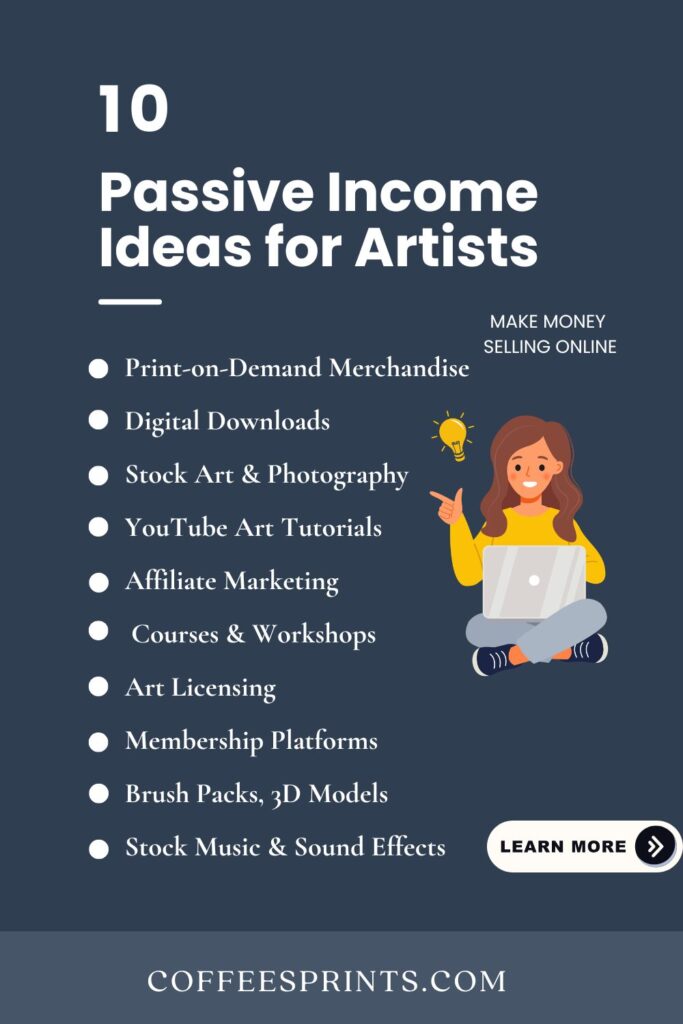
4. YouTube Art Tutorials
Record your art process. Upload it to YouTube. I get it that it takes months if not an year to monetize on YouTube with current trends, but once they get views, they earn from ads, sponsorships, and affiliate links. So you need to play the long game here. You can also convert them into a course or link your shop to your YouTube channel so people can buy products from you or learn the course. More about that in a bit.
Content that works: Speedpaints, brush technique tutorials, color theory explainers, “how I made this” breakdowns.
Passive after upload: Evergreen tutorials (like “How to Paint Realistic Skin Tones”) get views for years.
Earnings : $1-$6 RPM (Revenue Per Mille – what you actually earn per 1,000 views after YouTube’s 45% cut). Art/creative niches typically earn $2-$4 RPM. Finance and tech earn higher ($7-$11 RPM), but entertainment/creative content sits lower.
What that actually means: 10,000 views = $20-$60. 100,000 views = $200-$600. Plus sponsorships and affiliate links once you hit 10k+ subs.
Choose topics based on your niche. The best part? If you’re an introvert like me, you don’t need to be on camera. Screen recordings + voiceover work fine. Once the video is up, it works for you.
5. Affiliate Marketing
Promote the tools you already use. When someone buys through your link, you earn a commission.
How it works: You share affiliate links in your YouTube descriptions, blog posts, Instagram bio, or Pinterest pins. Someone clicks, buys, you get paid.
Commission rates:
- Amazon Associates: 4-10% (art supplies, books, tech)
- Blick Art Materials: 8-15%
- Cheap Joe’s Art Stuff: 8-12%
- Procreate, Clip Studio Paint, Adobe: Varies by program
Setup: Create a Linktree or Stan Store with your favorite tools. Add it to your bio. Mention it in your content.
Passive potential: Links in evergreen blog posts or YouTube videos earn for years.
Example: “My Top 10 Watercolor Brushes” blog post or video or Instagram reel with Amazon affiliate links. Earns passively every month.
The best part? You’re recommending things you already use. No fake promotions like some influencers out there. Just honest recommendations that happen to pay you.
6. Online Courses & Workshops (Pre-Recorded)
Record a course once. Sell it forever. You can use your YouTube, blog, or Instagram traffic sources, or you could run ads if you can afford a budget.
Platforms: Skillshare, Udemy, Teachable, Gumroad.
Earnings:
Depends on platforms, views, and sub-niches. Here are some rough estimates just for an idea.
- Skillshare: $0.10-$0.30 per watch minute (2026 rates dropped from previous years)
- Udemy: $2-$10 per student (platform takes 50-75% cut depending on source)
- Teachable/Gumroad: You keep 90%+ margins, but you handle all marketing
Recording time: 10-20 hours for a solid course (filming, editing, uploading).
Pricing (if self-hosted): $29-$199 depending on depth.
This takes more upfront work than most items on this list. But once it’s done, it’s done. And if it’s good, it sells for years.
7. Art Licensing
License your artwork to companies who put it on greeting cards, fabrics, home goods, stationery, phone cases, etc. You get paid per sale or upfront.
How it works: Companies license your design, manufacture products with it, and pay you royalties (usually 5-10% per sale).
Where to start:
- Society6, Redbubble (built-in licensing options)
- Direct outreach to stationery brands, home goods companies
- Portfolio sites like ArtLicensingShow.com
Best for: Surface pattern designers, illustrators with cohesive styles.
Reality check: This takes time to break into. But once you land a few deals, the checks come automatically.
8. Membership Platforms (Patreon, Ko-fi)
Offer exclusive content to paying members. They pay monthly. You deliver value monthly.
What you’re offering: Behind-the-scenes sketches, WIP files, exclusive brushes, live painting streams, monthly tutorials, PSD files.
Pricing tiers: $3-$25/month per supporter.
Retention rate: 60-80% if you’re consistent.
Average earnings: $500-$5,000/month for established creators with 100-500 patrons.
Example tier structure:
- $3/month: Early access to finished work
- $10/month: PSD files, brush packs, sketches
- $25/month: Monthly live painting session + 1-on-1 feedback
This isn’t 100% passive because you need to deliver monthly. But it’s recurring revenue, which is close.
9. Brush Packs, Photoshop Actions, 3D Models
Sell digital tools that other artists use.
What you’re selling:
- Procreate brush sets
- Photoshop actions (one-click effects)
- Blender 3D models
- Texture packs
- Custom shapes
Platforms:
- Creative Market (70% royalties)
- Gumroad (90%+ margins)
- Ko-fi Shop (similar margins)
High-demand items:
- Watercolor texture brushes
- Ink splatter effects
- Hair and fur brushes
- Vintage grain overlays
One-time creation, thousands of sales: A single well-made brush pack can sell 5,000+ times at $5-$15 each.
This is especially lucrative if you’ve developed a signature texture or effect. Package it. Sell it.
10. Stock Music & Sound Effects (For Audio Artists Only)
If you make music or sound design, license tracks to stock music platforms.
What you’re selling: Background music, ambient loops, sound effects, beats.
Platforms: AudioJungle, Pond5, Epidemic Sound, Artlist.
Earnings:
- Royalty-free licenses: $10-$50 per download
- Sync licensing (TV, ads, games): $500-$5,000 per placement
Passive potential: Upload your library. It earns every time someone licenses a track.
High-demand genres: Lo-fi beats, corporate background music, nature ambience, upbeat montage tracks.
Audio is undersupplied compared to visual art. If you make music, this is a goldmine.
Realistic Earnings Timeline (So You Know What to Expect)
Take it with a pinch of salt as it also depends on the time you invest and sub-niches you sell on.
| Months Active | Expected Monthly Revenue | Key Milestones |
|---|---|---|
| 1-3 | $50-$300 | 5-10 products live, first sales trickling in |
| 4-6 | $300-$1,000 | 20+ products, starting to see repeat patterns |
| 7-12 | $1,000-$3,000+ | Multiple income streams, 3k-5k audience |
Most artists earning $1,000-$2,500/month passively are combining 3-5 of these streams. They didn’t get there overnight, it’s a long road. But you get there by setting up one stream, then another, then another—over 6-12 months.
The Real Reason Most Artists Don’t Do This
It’s not because passive income doesn’t work. It’s because setting it up feels like extra work when you’re already burned out from the hustle.
But here’s the thing: you’re going to be tired either way. You can be tired from posting on Instagram every day and hoping someone buys a commission. Or you can be tired from building systems that eventually let you step back.
The artist in that Reddit post? They were already doing the hard part—creating good work. They just weren’t multiplying it.
You don’t need to be more creative. You need to be more strategic about how your creativity earns.
Stuck on Which Revenue Stream Makes Sense for Your Work?
Here’s the problem most artists run into: they know they should be doing something to generate income, but they don’t know which avenue actually makes sense for their specific work, audience, or skill level.
Should you focus on Etsy or print-on-demand? Is YouTube worth it if you hate being on camera? Is TikTok or Tumblr still worth it? And what about SEO—how do you even rank on these platforms when you’re competing with thousands of other artists?
These aren’t just tactical questions. They’re strategic ones. And getting them wrong means spending months building the wrong thing.
That’s where the Marketing Clarity Sprint comes in.
It’s a focused, 5-day process where I help you:
Figure out which income and traffic streams actually fit your work — Not every artist should be on YouTube. Not every illustrator should sell courses. We’ll map your strengths, your audience, and your goals to the 2-3 revenue streams that make the most sense for you.
Identify your SEO and discoverability gaps — Whether it’s Etsy listings that aren’t ranking, a Pinterest strategy that’s going nowhere, or an Instagram account that gets zero views, I’ll diagnose what’s broken and what to fix first.
Build a 90-day monetization roadmap — You’ll walk away with a clear plan: which platforms to use, what content to create, how to price it, and what to do in month 1, month 2, and month 3.
This isn’t a generic “here’s what works for everyone” consulting call. It’s specific to your work, your niche, and where you are right now.
Marketing Clarity Sprint with a 5-day turnaround. Written audit + 30-minute strategy call. I’ll give you clear next steps you should take.
I’ll help you map out which streams make sense for your work.
Good luck with your art!