The Only Product Launch Checklist for B2B SaaS Startups

You’ve poured six months into building that killer feature. Engineering crushed it. Launch day hits… and crickets.
Sound familiar?
Hey, you’re not alone—most B2B SaaS launches fail not because the product or the feature sucks, but because execution tanks them. Data show about 67% miss revenue targets in the first 90 days.
This post fixes that. I’ll walk you through my 6-phase framework — a practical product launch checklist for B2B startups.
In this post, we’ll cover why launches fail, a quick readiness check, and the full product launch checklist you can download for free.
Ready? Let’s get started.
Why Most Launches Fail (And How You Can Fix It)
You post on LinkedIn, email the list, and follow what looks like a decent product launch plan, but you still fail to generate initial traction.
Here’s why:
- No positioning. Skip “Why care?” Get “Excited for [Feature]!” noise.
- No alignment. Sales can’t pitch. CS can’t onboard. Support’s lost.
- Rushed content. Last-minute bland copy: “Powerful features.”
- No follow-through. Spike, then silence. No reviews, no tweaks.
This is exactly why you need a structured go-to-market checklist instead of random launch activities.
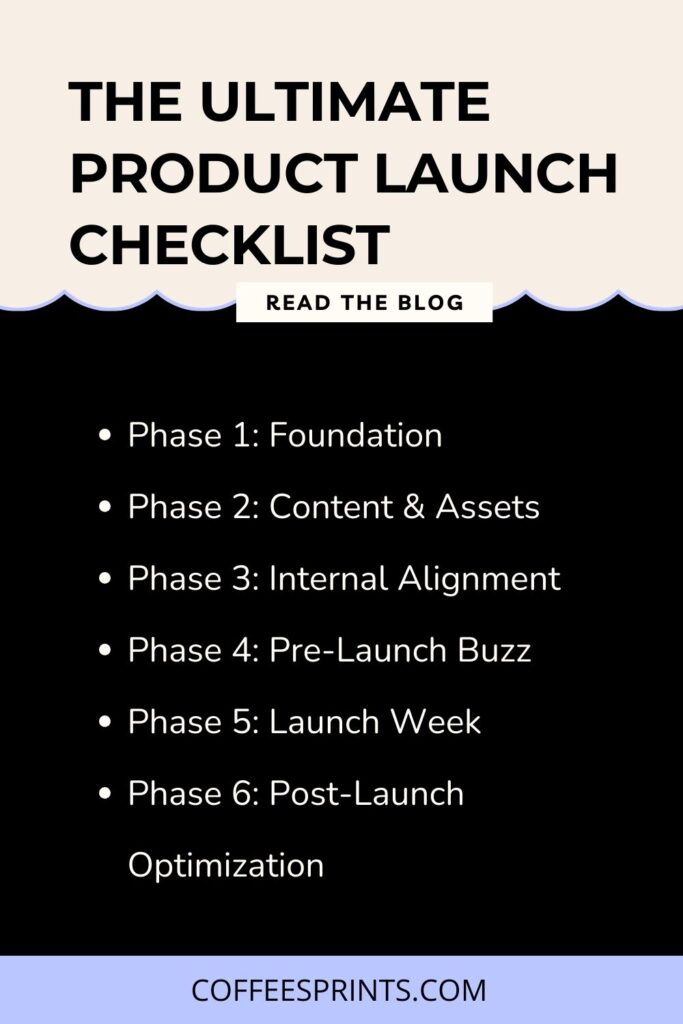
Here are the 6 phases that fix your product launches and form a complete SaaS GTM checklist.
Phase 1: Foundation
Most launches succeed or fail at this stage of your product launch plan.
This is not the time to write landing page copy or draft social posts. It’s the time to get brutally clear on strategy—this is the first section of any serious product launch checklist.
You need precise answers to five questions:
- Who is this actually for? Define your ICP in detail—industry, tech stack, stage, urgent pain points, buying triggers. “B2B SaaS” or “startups” is not a real answer in a serious B2B product launch.
- What specific problem does this feature solve?
- Why should customers believe your claim? What proof points support it?
- How is this meaningfully different from existing alternatives?
- What metrics will define success for this launch?
The outputs should include a positioning statement, a clear value proposition, a messaging framework, a competitive analysis, and defined success metrics—core elements in any solid SaaS launch checklist.
One of the most common mistakes I see is vague targeting. If your ICP is described as “startups,” you haven’t done the work. Which startups? Seed-stage fintech? Series B vertical SaaS? What urgent problem keeps their CMO or Head of Ops awake at night? If you can’t answer that, your messaging won’t convert later.
When this foundation is solid, everything else in your go-to-market checklist performs better.
Phase 2: Content & Assets
With positioning locked in, you move into execution—the asset-building stage of your product launch checklist.
Now you create the materials that will actually sell the feature:
- An updated product or feature page
- A strong sales one-pager
- A structured demo script
- Two to three use case pages
- A launch email sequence
This is where many teams fall back into vague language. Phrases like “powerful capabilities” or “advanced functionality” don’t persuade anyone. What persuades is specificity. For example: “Reduces onboarding time from 14 days to 3.” That’s tangible. That’s measurable. That’s compelling.
A simple test within your SaaS GTM checklist: Can you write three clear use cases with before-and-after outcomes? If you can’t, your positioning isn’t strong enough yet. Go back and refine it before investing more in assets.
Phase 3: Internal Alignment
Even the best messaging fails if the team can’t deliver it—this is a critical step in any B2B product launch.
At this stage, alignment across departments is critical. Sales needs to confidently pitch the feature and handle objections. Customer success must understand how to onboard and support it. Support should be prepared for edge cases. Product needs to ensure analytics are properly set up to track adoption and impact.
I recommend running a focused 60-minute workshop. Have sales role-play real objections. Build battle cards that compare your feature to competitors. Clarify key talking points and disqualifiers.
I’ve seen technically flawless launches collapse because sales didn’t know how to explain the value clearly. Alignment is not optional—it’s operational insurance built into your product launch plan.
Phase 4: Pre-Launch Buzz
A common mistake in many SaaS launch checklists is treating launch day as the starting line. In reality, it’s the midpoint of your visibility push.
Instead of announcing cold, build anticipation. Two weeks out, signal that something meaningful is coming. One week out, share a preview—perhaps a UI snippet or a beta result. A few days before launch, clearly articulate why this feature matters and who it’s for. Then, on launch day, deliver the full story.
Channels may include email, LinkedIn, or X, targeted outreach, and, if relevant, a platform like Product Hunt.
Cold launches get ignored. Warm audiences pay attention—this is a key principle in any effective go-to-market checklist.
Phase 5: Launch Week
Launch week should be orchestrated like a coordinated campaign, not treated as a single announcement. This is where your product launch checklist moves from planning to execution.
For example, you might go live early on Product Hunt (if it’s part of your strategy), email existing customers first to activate advocates, publish a detailed blog post explaining the “why now,” and then execute coordinated social and sales outreach throughout the day.
Most importantly, stay active. Engage in comments. Respond to questions. Monitor feedback. Too many teams announce the feature and then go silent. That’s wasted momentum—and a breakdown in your product launch plan.
Phase 6: Post-Launch Optimization
This phase separates average launches from high-performing ones and completes your SaaS GTM checklist.
After launch, review performance against your original targets. Identify which messaging resonated and which didn’t. Document objections that surfaced during sales calls.
Then act on it:
- Interview five to ten new users to understand what motivated them—or what nearly stopped them.
- Analyze signups, activation rates, and pipeline impact.
- Refine landing pages and sales scripts based on real objections.
- Turn early wins into case studies.
- Plan a 90-day content push that reinforces the feature’s value.
A launch is not a moment. It’s a window of opportunity. Most teams stop too early and leave revenue on the table because they treat their product launch checklist as complete on day one.
A Quick Reality Check Before You Ship New Features
Before you go live, answer these questions honestly. This is your final internal go-to-market checklist review:
- Can you explain the value proposition in one clear sentence?
- Can sales demo the feature confidently without reading from a script?
- Do you know who this feature is not for?
- Do you have at least three concrete use cases with measurable outcomes?
- Has someone outside your team tested the full signup-to-activation flow?
If any of these answers is no, delaying the launch is often the smarter decision. Rushed launches rarely perform well. Strong foundations compound—especially in a competitive B2B product launch environment.
The Full Product Launch Checklist
The complete product launch checklist includes over 40 tasks, positioning templates, email and asset templates, timeline breakdowns, and structured self-assessment prompts. It functions as a practical SaaS launch checklist, SaaS GTM checklist, and execution-ready product launch plan.
It’s designed to remove guesswork and replace it with a repeatable system.
If you’re serious about turning feature launches into revenue drivers instead of internal milestones, use a structured product launch checklist. That’s what makes the difference.